Advertising and Marketing
How and why media language is used by media producers to create meaning.
Definitions
Advertising - Is the process of making a product or service known to the market and the target audience.
Marketing - is the process of preparing a product for the marketplace. Advertising is one of several components used in the marketing strategy.
Media language - How the media through their forms, codes, conventions and techniques communicate meaning(s).
Representations - How the media portray events issues, individuals and social groups.
Media language :
- Genre conventions of camera, editing, sound and film set.
- How are these elements used together to construct the media form so that it looks the way it does.
- How are these elements organised and combined in a certain way to communicate meaning in the set product.
- How does the genre develop through the use of technical elements
- How does the contents incorporate the viewpoints and ideology of the producer?
- How can multiple meanings be communicated and interpreted by producer and audience.

Representation:
- Which different groups, individuals and or events are presented in each of the set products
- What positive and negative stereotypes are evident and why?
What conclusions can we make about these representations
- Which groups are mis-represented and under-represented
- How are representations constructed as real
- For an understanding of the social and Cultural contexts which influence how groups/individuals are represented please refer to page 126 of the OCR notes.
Adverts as a media form.
Print advertising uses physically printed media and usually appears in magazines, newspapers, billboards or posters.
Studying media language
Three main areas of study include
•Codes and conventions
•Genre
•Constructing and interpreting meaning.
Media Language elements can be divided into two distinct elements .
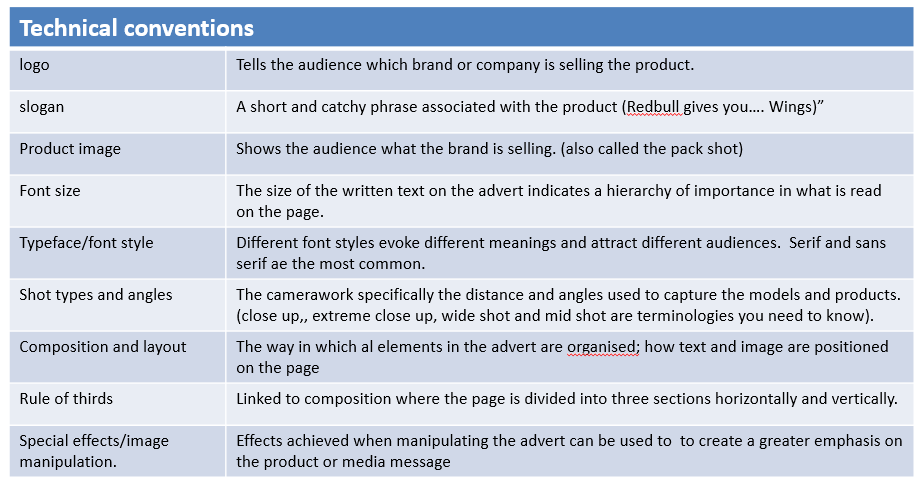
Technical conventions:
•This refers to the actual technical construction of the advert for example the colour palette or the shot type
•Techniques to persuade:
•This refers to content, or the message created by the combination of technical elements, that persuade the audience to buy the product.



RULES OF THIRDS


C – Class
A – Age
G- Gender
E – Ethnicity
D - Disability
Representation In Adverts
Representation is unavoidably selective. The producer of an advert will decide how to promote the product to his target audience and in so doing will decide how to represent particular social groups or individuals. Producers may consciously or subconsciously reflect wider social attitudes to a range of issues or events this can result in bias for reasons described in page 131 of the OCR notes


-
Representation in media studies means thinking how an event, issue, particular social group is presented to an audience through a media product
-
Representation is unavoidably selective. The producer of an advert will decide how to promote the product to his target audience and in so doing will decide how to represent particular social groups or individuals.
-
Producers may consciously or subconsciously reflect wider social attitudes to a range of issues or events this can result in bias for reasons described in page 131 of the OCR notes
-
Representation in media studies means thinking how an event, issue, particular social group is presented to an audience through a media product.
CAGED (acronym) provides a starting point for analysing print adverts in terms of:
- Which groups tend to be represented positively, negatively or not at all.
- What messages and values are communicated about different social groups and individuals as a result.
- Many adverts reinforce heterosesexual values therefore the mnemonic can be developed further to read as CAGEDS.
Selection and combination of events, issues, social groups and individuals.
-Refers to what and who we see in the advert and how these elements are combined to construct particular meaning.
Choices made about how to represent.
-Refers to the decisions made about how to construct the representations we see. these choices depend on the values of the advertiser, the target audience and the product being sold.
The use of positive and negative stereotypes
-Refers to any stereotypes used to construct meaning about different events, issues, social groups and individuals in an advert. Question whether these reflect wider common stereotypes used in advertising or are something different to what we would expect.
Social groups who are underrepresented or misrepresented.
-The CAGEDS mnemonic can be used to identify which social groups are represented by the advert. Question how and why subordinate social groups are represented or absent.
Impact of industry contexts on choices producers can make.
-Representation choices in adverts are usually driven by economic factors relating to the advert's message and reach the product's intended audience.
How media through re-presentation constructs versions of reality.
-Refers to the way a print advert may use stereotypes as short cuts to communicate the advert's message and reach the products intended audience.
How representations makes claims about realism.
-Claims regarding realism in a print advert are made through the way media language used influences the reader to accept its representations as real rather than simply a point of view.

Colour Wheel


lucozade - context
created in 1927 as glucozade - meant to give energy to the sick
renemed lucozade in 1929
1983 rebranded as a sports dink instend of a helthy drink in the 80s
Preferred or dominant - they agree with the adverts meaning and buy the product.
Negotiated - they accept the message from the advert by may not want to buy the product.
Oppositional - they reject the message from the advert and will not buy the product.
The able man would more than likely buy the drink and believe in the message espectital if the man considers himself to be sporty or wants to be sporty, therefore putting himself in the preferred or dominant section.
While the able women may also be in the preferred or dominant section, due to the adverts for this sport drink being mostly male she may feel as through the drink is not made for her and will therefore revert to being in the negotiated section or the oppositional section.
The man in the wheelchair will most likely not believe the drink is suited for him and therefore will reject the drink altogether as the company has failed to include his disability in their advertisement. this would put them in the oppositional section. (Although there are a few exceptions such as if the person in the wheelchair was into sports themselves then they may be in the dominant section).
OLD SPICE
Definitions
Media language : How the media through their forms, codes, conventions and techniques communicate meaning(s).
Representations
How the media portray events issues, individuals and social groups.
Mesculinity
-
Strong
-
Rational
-
Public, work-orientated
-
Active
-
Rough
-
Uncaring
-
Insensitive


Old Spice represents itself in a humorous way as the body sent for all men.
The advert is actually somewhat aimed to women (not a lot but they continuously talk as if they are talking to the women in the room) this is so that women will buy their boyfriends this product as women tend to be more into shopping and will also fancy the person in the advert.
But that doesn't mean the advert is not for men as it is a product for men to use, they interest men to but the product as suggesting that they too can be rich and famous (selling the dream). It uses masculinity stereotype to show that men should be strong and physically attractive j

Old Spice | The Man Your Man Could Smell Like
as well as playing on the black stereotype of being funny yet dangerous.
The advert represents the man in the ad as a exotic character, it shows he is a little bit dangerous and are stereotype as comedians as well as a somewhat sexually being.
It pretty much shows the ideal type of man for women in the modern whole (caring but also strong and attractive as well as buying gifts the female actually like "like tickets to their favourite show".

Very old ad from 1970s showing how old spice use to target people revealing that until recently when the brand had a upgrade only most old people would buy the product.
The ad features a white male (somewhat racist as there is no black people) it shows women as the weaker minority as whenever a women is shown it is because they are either fainting or sexually attracted to the man using the body sent.
The advert also sells the dream at the time of being able to escape and travel across the sea. the advert is even in black and white due to the image just being that old at the time when there was no colour tv.


He be the island, and the people on the island are either having fun or are being funny such as the guy running from the fish and the dancing monkey.
Sells the dream, uses the famous guy to draw in customers.
Topical beach, having fun and nice weather.
Made from amazing stuff and from Bahamas


female gaze - is when women objectify men as they find them sexually attractive. meaning that men will buy the product to have women like them.

The advert has been made specifically surrounding these elements so that everyone has something to relate to the advert by and this is also way humour is used.

Postmodernism
-
A late 20th-century style and concept in the arts, architecture, and criticism, which represents a departure from modernism and is characterized by the self-conscious use of earlier styles and conventions, a mixing of different artistic styles and media, and a general distrust of theories.
Viewpoints and ideologies
Old Spice Smell like a man campaign can be seen to reinforce patriarchal ideology.
The use of Isaiah Mustafa to promote the product and slogan will reinforce the ideological dominance of men within society.
The advert constructs representations that communicate to men and women. The idea that the product if purchased willlead to self fulfilment and men become better men.
The advert draws on common patriarchal stereotypes such as
• White men (most powerful/strong and in control)
• Black men (sports / crime)
• Weak women (cant do anything must stay at home)
It uses visual codes in media language to appeal to the target audience.
The advert also reinforces ideological assumptions about :
-The appearance of others
-Consumerism
-Individualism
The representation of masculinity also (arguably) reinforces ethnic stereotypes of the hypersexualised black male within the media.
faecal expressions

Part Three


